How a 55-year-old woman from Charleston prepared for Mount Kilimanjaro, navigated training burnout and knee pain, and discovered a level of physical strength she hadn't known she possessed.
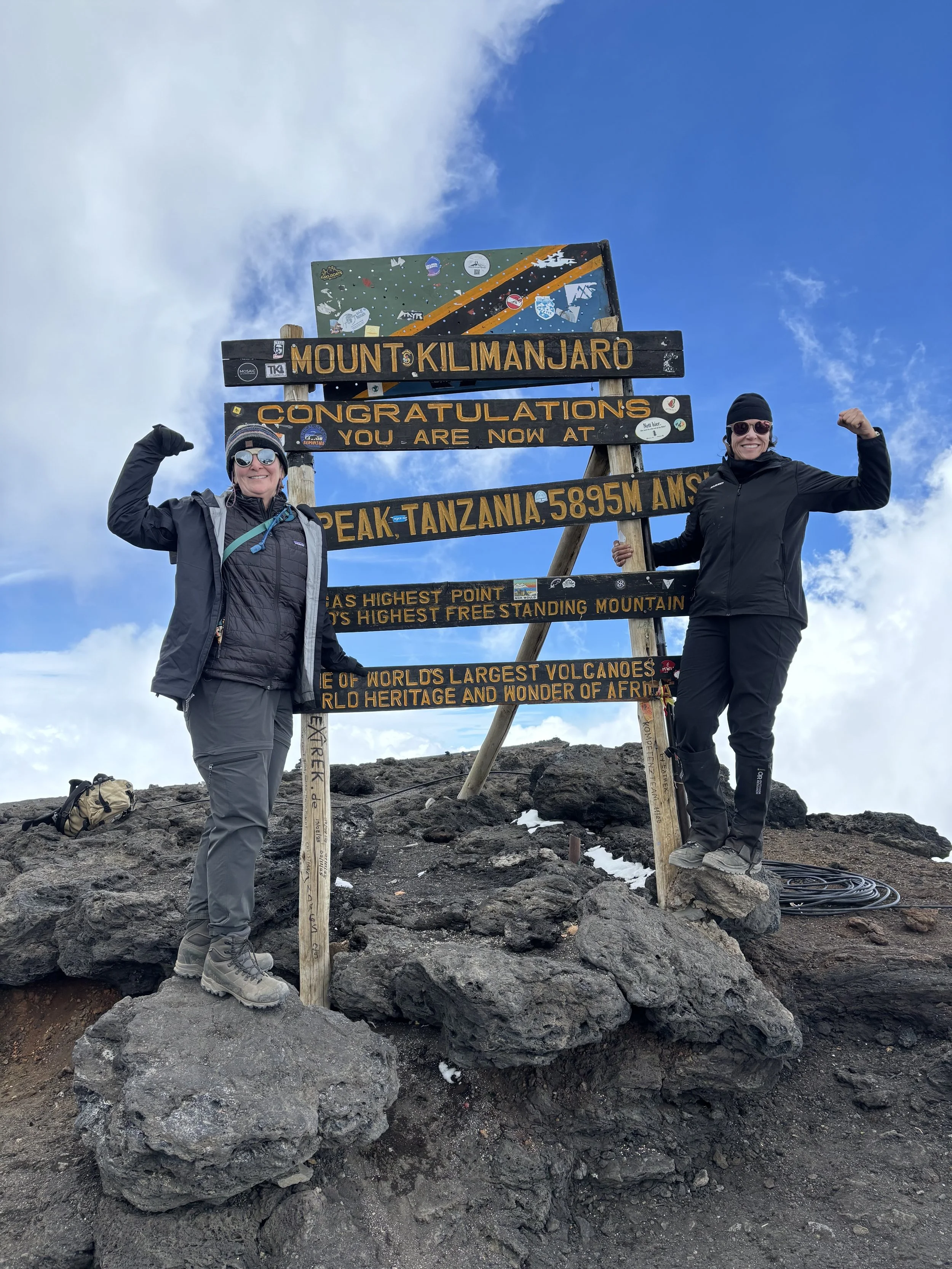
When Ellen reached the 19,341-foot summit of Mount Kilimanjaro, she experienced an emotion she hadn't expected.
Surprise.
At 55, Ellen thought she knew herself pretty well. She loved traveling, intellectual challenges, and the comforts of a good hotel. She had trekked in Nepal decades earlier, but climbing mountains wasn't something she imagined doing at this stage of life.
In fact, she joked that she generally preferred admiring mountains from an airplane.
Yet here she was, standing on top of Africa's highest mountain after months of training, difficult practice hikes, recurring knee pain, and a summit ascent that had tested her endurance.
"I thought I knew myself well enough that I no longer surprise myself," she reflected afterward.
But Kilimanjaro had introduced Ellen to a side of herself she hadn't known existed.
Her journey began months earlier with a simple invitation from a friend.
An Unexpected Invitation to Climb Kilimanjaro
Ellen and her friend Katherine had known each other for approximately a decade through their involvement in a national women's nonprofit organization.
They shared a love of travel and had already explored destinations together, including Paris and Egypt.
Katherine had long been fascinated by Mount Kilimanjaro. Her father had traveled to East Africa for work and volunteer activities, and the mountain had captured her imagination.
Eventually, she mentioned the possibility of climbing it to Ellen.
Ellen agreed without hesitation.
That enthusiasm would soon meet the realities of preparing for a demanding high-altitude trek.
The two friends selected the Western Approach with Thomson Treks, but their physical backgrounds could hardly have been more different.
At 66, Katherine was an experienced endurance athlete who regularly participated in open-water swimming, cycling, running, and other demanding activities.
Ellen was active, too, but her fitness routine leaned toward Pilates, barre, strength training, walking, and recreational hiking.
She wasn't accustomed to the sustained cardiovascular demands of endurance sports.
As she later explained on the HikeStrong Podcast:
"Give me an intellectual challenge, ask me to learn a new language, no problem. A physical challenge? That definitely gives me pause."
Ellen also had some prior experience trekking at altitude.
In October 1995, she had completed a 15-day trek in Nepal, reaching approximately 15,500 feet.
But she was in her twenties then and hadn't trained at all.
Thirty years later, preparing for Kilimanjaro would be a very different proposition.
Building Hiking Fitness Without Mountains
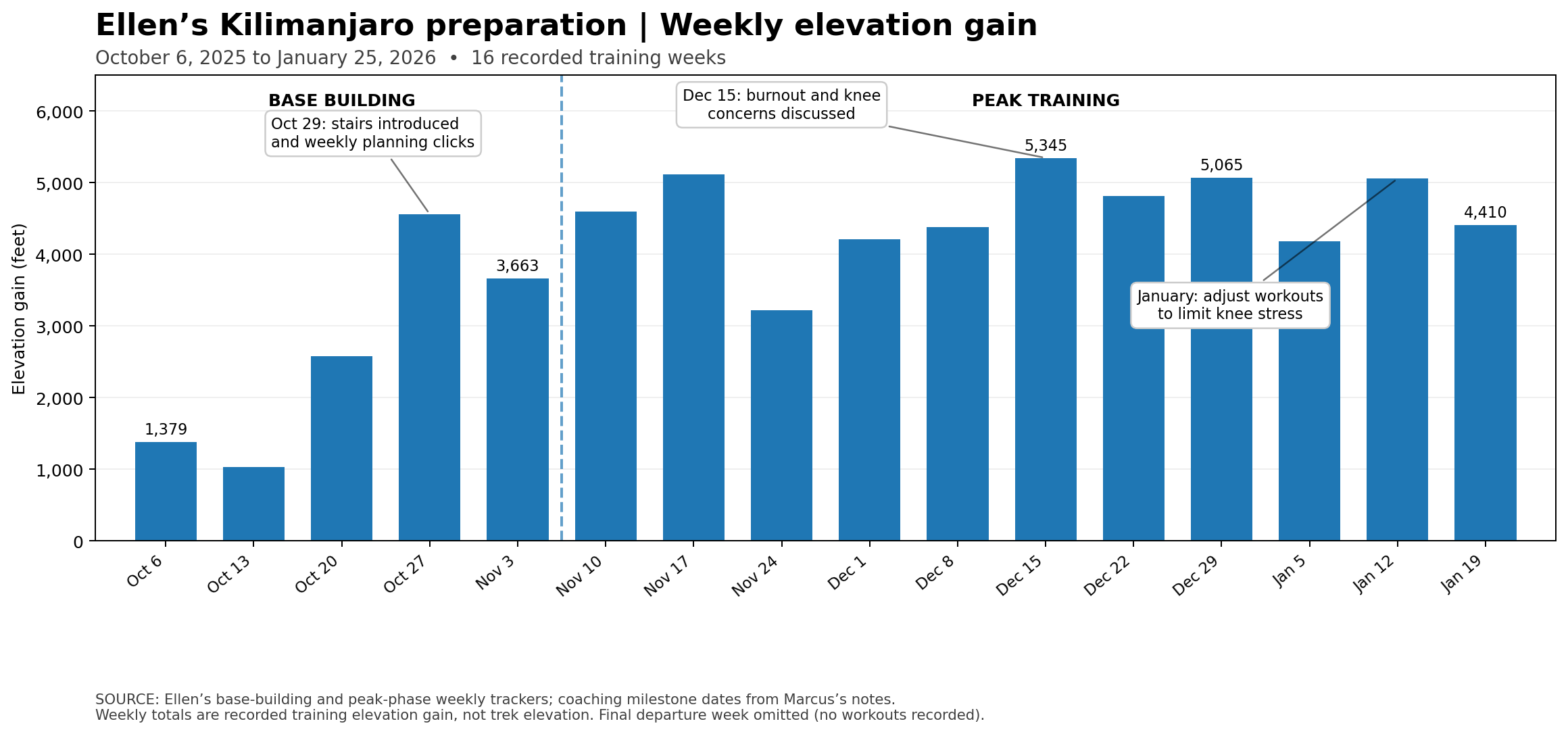
Ellen began working with hiking strength and conditioning coach Marcus Shapiro in October 2025 through Fit For Trips, the predecessor to HikeStrong.
The objective was to develop the physical capabilities required for her upcoming trek, including hiking endurance, climbing strength, balance, and the ability to handle repeated days of demanding terrain.
Living in Charleston, South Carolina,Ellen didn't have regular access to mountains where she could accumulate thousands of feet of elevation gain.
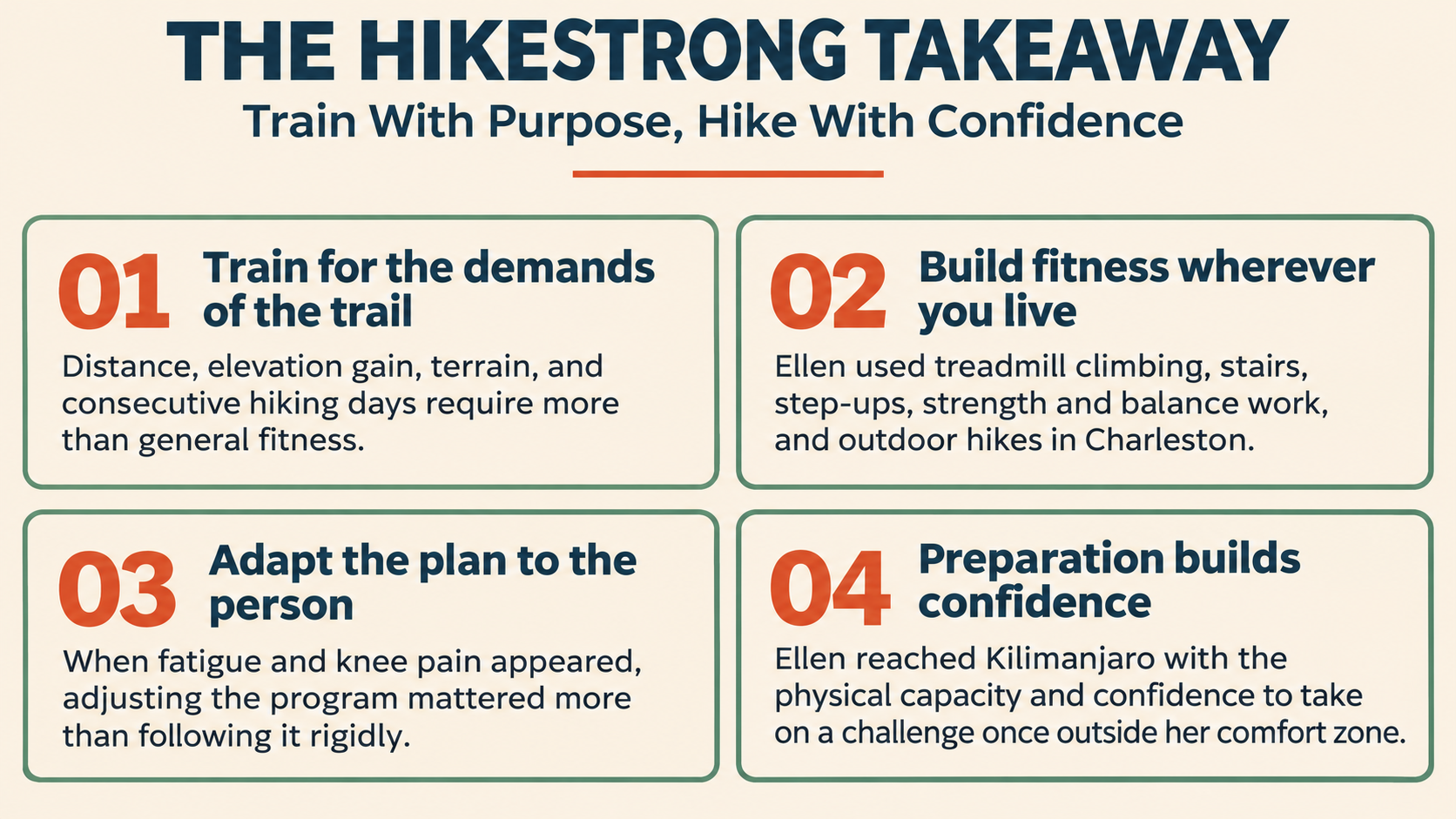
Instead, her preparation relied on a combination of treadmill climbing, stairs, stair-climbing machines, step-ups, hiking, walking, and progressive strength and balance exercises.
Her training program established measurable weekly distance and elevation-gain targets.
She could accomplish those targets through different activities depending on her schedule and available equipment.
But there was an unexpected learning curve.
"I didn't know there was going to be math involved in this hike."
Ellen initially found the training calculations frustrating.
A treadmill workout contributed distance and elevation gain differently from a stair workout or a session of step-ups.
She needed to understand how those activities translated into her weekly targets and then plan her workouts accordingly.
During an October coaching session, Marcus helped her map out a sample training week, showing how to convert the overall goals into individual workouts.
By November, Ellen understood the system.
She developed a routine of reviewing her targets at the beginning of each week and calculating how she would accomplish them.
Ellen also liked the fitness routine she already had and didn’t want to give it up.
Pilates and barre weren't simply exercises. They were activities she enjoyed and opportunities to connect with other people.
Initially, she hoped to fit Kilimanjaro training around everything else.
Eventually, she recognized that the commitment required some trade-offs.
"I really liked my life that I had before the training," Ellen explained.
She began prioritizing the workouts most directly related to Kilimanjaro, even when that meant temporarily stepping away from some of her favorite classes.
It was the beginning of a shift from exercising for general fitness to training with a specific purpose.
The Training Numbers: What Ellen Actually Accomplished
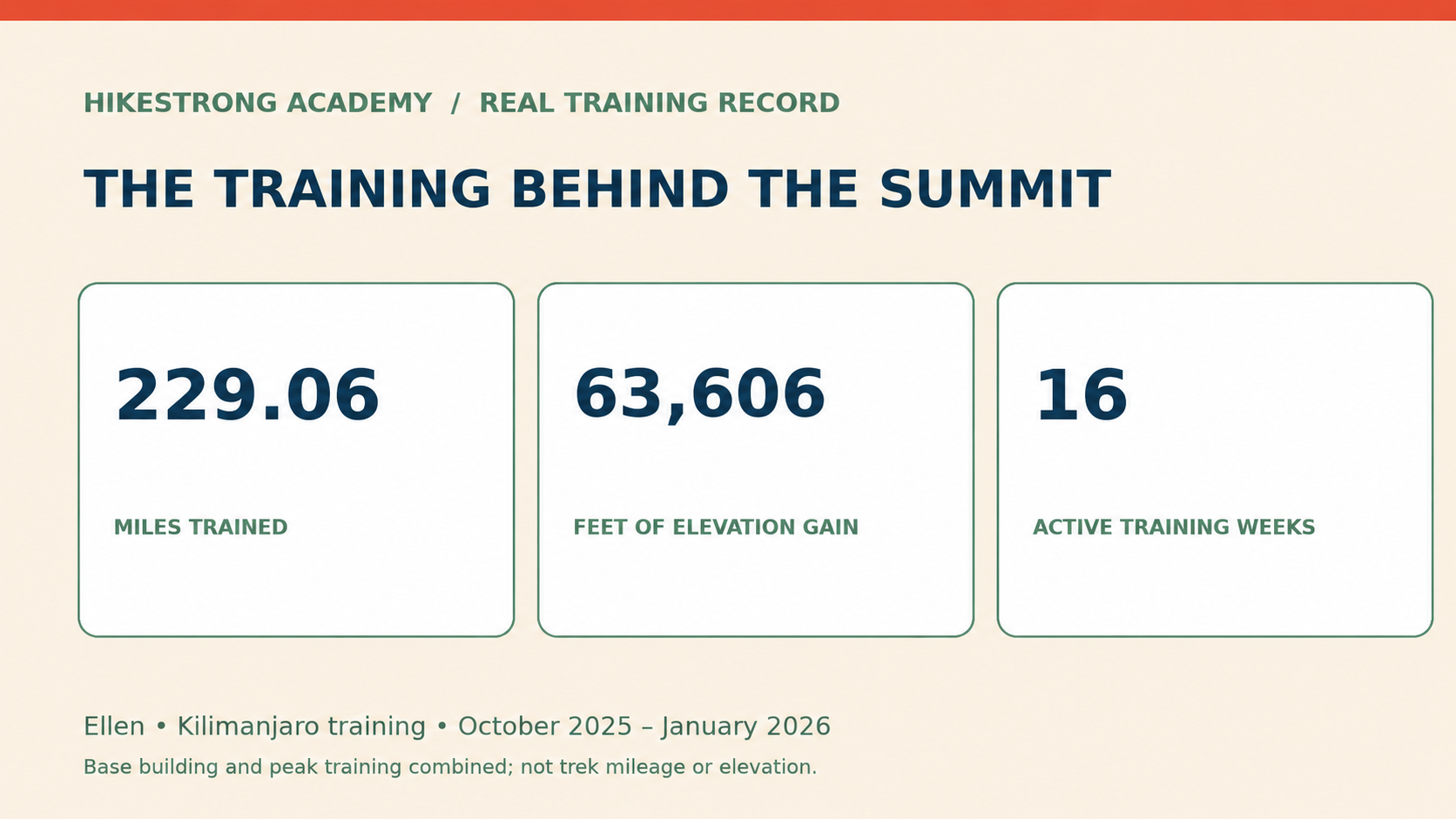
Ellen’s cumulative training totals, not the distance or elevation gain completed on Kilimanjaro.
Her peak-phase chart shows that the majority of recorded elevation gain came from controlled workouts rather than outdoor mountain hikes.
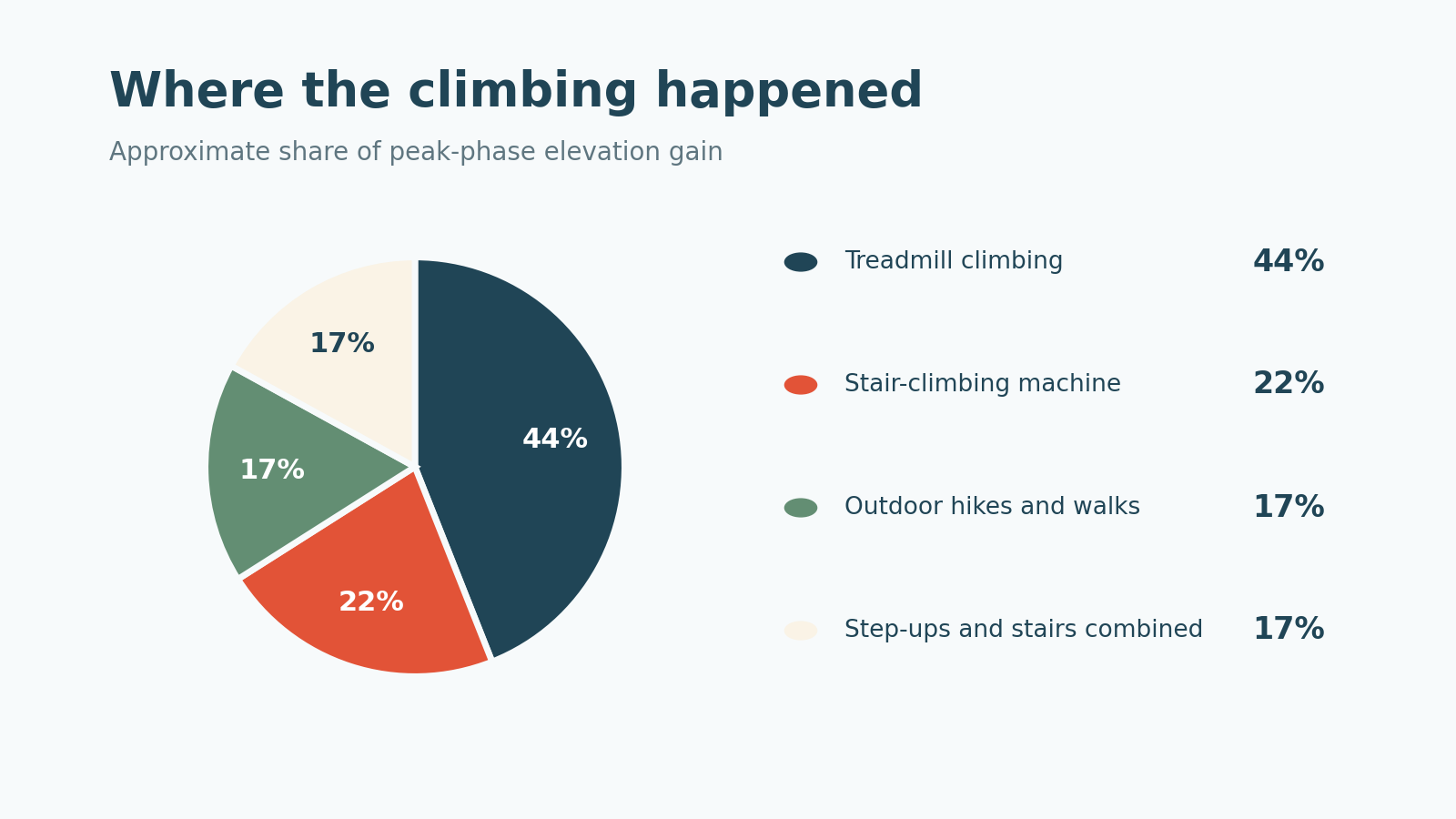
The percentages are approximate and reflect recorded peak-phase elevation gain.
But the numbers tell only part of the story.
The Moment Ellen Realized Her Training Was Working
As the weeks progressed, Ellen began noticing meaningful improvements in her strength and stamina.
The milestone challenges were particularly revealing.
These demanding workouts required her to accumulate substantial elevation gain through multiple activities, often over several hours. During her final major elevation milestone challenge, Ellen combined approximately 2,000 feet of treadmill climbing, 1,450 feet on a stair-climbing machine, and 600 feet of step-ups into one demanding workout.
She discovered she could complete them without feeling exhausted afterward.
Her outdoor training hikes with Katherine provided another measure of progress.
Over approximately three months, the friends completed three substantial hikes together.
These outings allowed them to practice navigating unfamiliar trails, using trekking poles, managing food and hydration, and handling the physical and mental demands of long days outdoors.
They also learned that hiking involved more than simply having strong legs and good cardiovascular endurance.
Trail navigation, footing, changing terrain, equipment, and even the time of day could dramatically affect the difficulty of an outing.
Their final major training hike, in early January, delivered a particularly memorable lesson.
The 11-Hour Hike That Prepared Ellen for Kilimanjaro's Descent
Ellen and Katherine expected their January hike to take approximately eight or nine hours.
Instead, it took around eleven.
They started in darkness and finished in darkness.
The final two or three miles involved a steep, leaf-covered descent that Ellen compared to skiing downhill.
She fell several times, grabbing trees and branches to help control her movement.
At one point, concerned about being in the woods after dark, Ellen began making noise to discourage any nearby wildlife.
She later joked that the animals were probably already well aware of her presence.
The hike was physically exhausting, mentally demanding, and not something either woman wanted to repeat anytime soon.
Yet that hike proved invaluable.
On Kilimanjaro, navigating loose dirt and rock—known as scree—reminded her of January's slippery terrain.
The descent wasn't easy, but she knew how to handle it, drawing confidence from a tough day in the woods thousands of miles away.Unfortunately, those training hikes also contributed to a problem that was becoming increasingly concerning.
Ellen's right knee was hurting.
When More Training Was No Longer the Right Answer
By December, Ellen was dealing with two significant challenges.
The first was burnout.
She had spent weeks completing repetitive workouts and was beginning to feel mentally and physically fatigued.
She also missed her regular fitness classes and the social connection those activities provided.
The second challenge was recurring knee pain, particularly following demanding outdoor hikes with substantial descents.
Her knee had become swollen after some of those outings, raising concerns about whether continuing the original training volume might aggravate the problem.
Marcus and Ellen agreed that the additional fitness Ellen could realistically gain in the remaining weeks, was not enough to risk making her knee worse, so they agreed to modify her remaining training.
Her final major milestone challenge was reduced, and the emphasis shifted toward activities involving ascending rather than descending.
Treadmill climbing, stair-climbing machines, and step-ups allowed her to continue working on elevation gain while limiting the downhill demands that had been aggravating her knee.
The modifications were also intended to help her manage the fatigue and frustration she had been experiencing.
The coaching focus shifted from building as much additional fitness as possible to preserving the conditioning she had already developed.
Ellen had completed substantial preparation and so reducing her training volume didn't mean abandoning the goal.
She was beginning to understand that preparation wasn't simply about completing every workout on a spreadsheet.
It was about arriving at Kilimanjaro ready to perform.
When Ellen finally began her trek, she reported that her knee did not bother her during the climb.
Her experience illustrates an important training principle: the objective isn't to complete the maximum possible training volume. It's to arrive at the trail with the fitness and physical readiness required for the adventure.
Putting the Training to the Test on Kilimanjaro
In February 2026, Ellen and Katherine began their Kilimanjaro trek with Thomson Treks.
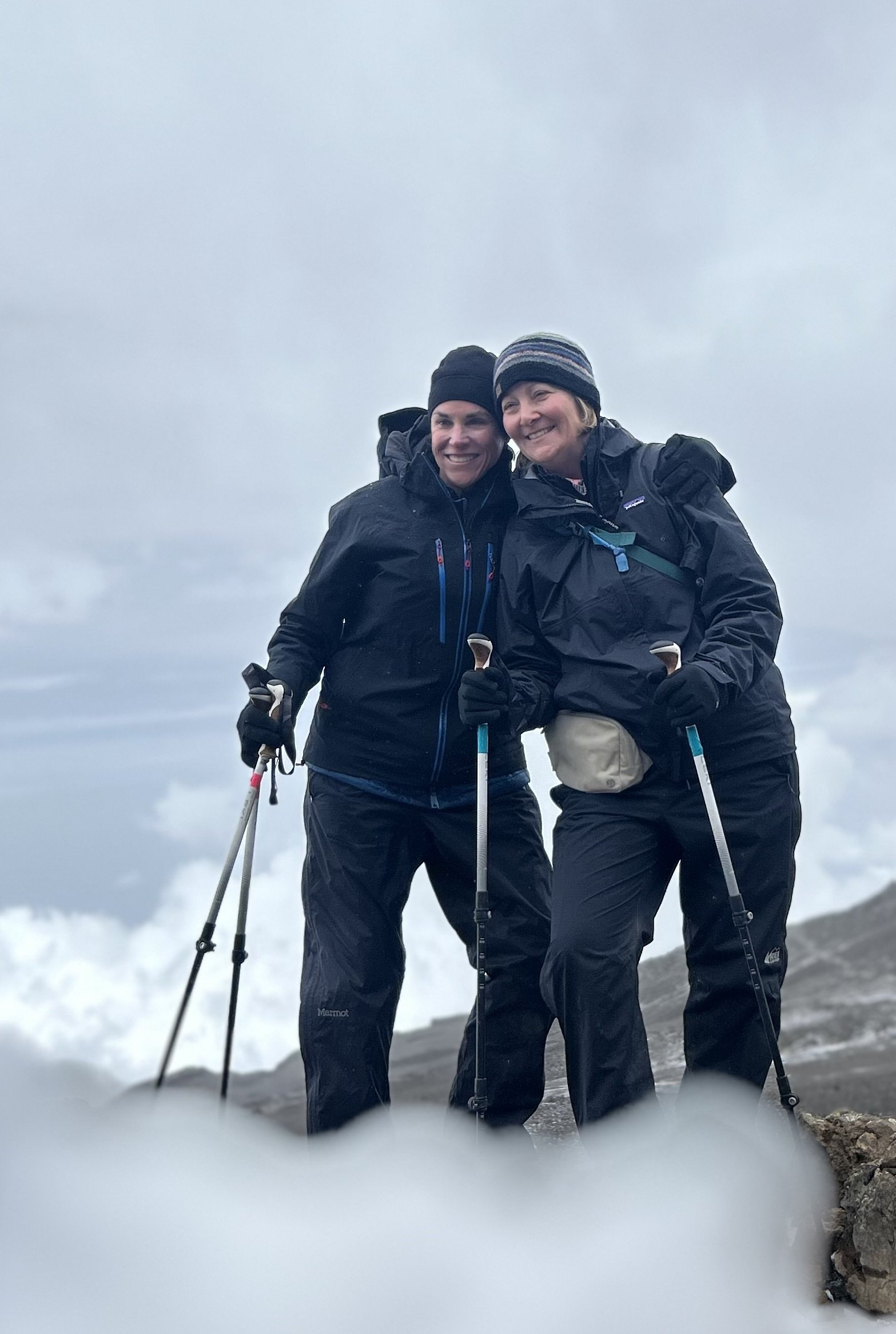
Over the following days, they encountered changing terrain, substantial elevation differences, and the progressively thinner air of high altitude.
Ellen repeatedly recognized the value of her preparation.
During descents, she felt confident in her leg strength and balance. Trekking poles provided additional support, and she consciously applied techniques she'd practiced during training.
The lunge and balance progressions were particularly valuable on uneven terrain.
She also appreciated her improved climbing strength during steep ascents and sections requiring scrambling.
One of those sections was the Barranco Wall, a rocky feature of the route that required hikers to negotiate large steps and uneven surfaces with assistance from their guides.
Ellen credited the strength and balance she'd developed during training with helping her feel more capable on that demanding section.
But no amount of preparation could eliminate every challenge.
For Ellen, the most difficult part was the sustained effort of climbing at high altitude.
Despite months of training, she struggled with breathlessness during portions of the ascent, especially on summit day.
Fortunately, Ellen and Katherine had experienced guides who understood the importance of adjusting the pace and supporting individual trekkers.
“I’m asking you to trust me.”
During the summit ascent, Ellen found herself toward the back of the group.
She preferred that position because she wanted to control her own pace.
But the lead guide, George, had another idea.
He asked her to move to the front.
Ellen refused.
She later admitted she could be a little stubborn, and this was one of those moments.
During a break, George approached her and explained that he wanted her beside him so he could establish a pace the entire group could sustain.
He also reminded her, gently, that he was in charge.
Then he made a request that stayed with Ellen.
"I'm asking you to trust me and I'm asking you to trust yourself."
That conversation changed her approach.
She accepted his guidance and continued climbing.
The moment reflected something larger about Ellen's Kilimanjaro experience.
Her determination had helped her prepare for the mountain, but reaching the summit also required trusting the expertise of people helping her along the way.
Reaching the Summit and Discovering Something Unexpected
Ellen reached Kilimanjaro's summit.
At 19,341 feet, she had climbed higher than at any previous point in her life.
Yet the achievement wasn't simply about reaching a particular elevation.
At 55, she thought she understood herself well enough that she could no longer surprise herself.
Kilimanjaro proved otherwise.
er willingness to attempt something unfamiliar revealed beyond what she'd imagined possible.
The meaningful achievement was accepting the challenge, committing to the preparation, and discovering what she could accomplish.
What Ellen Would Do Differently
Despite her successful climb, Ellen wished she had devoted more attention to cardiovascular endurance.
She observed that Katherine's extensive endurance background appeared to help her manage some of the ascents more comfortably.
Ellen felt she could have pushed herself further aerobically through treadmill climbing, stairs, and other cardiovascular workouts.
Her observation is valuable because it demonstrates that even successful preparation can reveal opportunities for improvement.
More Than a Mountain: What Ellen Took Home
Ellen's Kilimanjaro experience changed more than her perception of her physical abilities.
Her trekking group consisted of six women and one man, ranging in age from 55 to 66.
Being surrounded by people taking on such a significant challenge helped reinforce an important realization.
Middle age doesn't have to be defined by declining physical capability.
It can also be a time to develop strength, confidence, and abilities that haven't previously been explored.
Ellen described feeling physically empowered by the experience.
She also came away with a deeper understanding of good nutrition, seeing in real time that food is fuel for performance rather than something to be earned through exercise.
And she developed an even stronger appreciation for the people who supported her.
Katherine, Marcus, the local trainers who helped with her preparation, and the guides, porters, and fellow trekkers on Kilimanjaro all contributed to the experience.
The climb reinforced the importance of determination, preparation, community, and the willingness to accept help.
Perhaps most importantly, Ellen discovered that she was capable of far more than she'd previously imagined.
About This Case Study
Ellen trained with Marcus Shapiro through Fit For Trips, the predecessor to HikeStrong. The hiking-specific training methodology developed through decades of coaching now forms the foundation of the HikeStrong training app.
This case study draws on Ellen's base-building and peak-phase training charts, coaching notes and correspondence from October 2025 through January 2026, and Ellen and Katherine's firsthand reflections on the HikeStrong Podcast.
Listen to their story on the HikeStrong Podcast: Two Friends Climb Kilimanjaro at 55 and 66
Individual training experiences and outcomes vary. Ellen's training adjustments reflected her circumstances and should not be interpreted as a universal prescription for managing knee pain or preparing for high-altitude trekking.